Why the topic matters
Almost every internal automation conversation now includes some version of "can we just add AI to this." Sometimes it is a reasonable question about a specific bottleneck. More often, it is a vague hope that a large language model can absorb an entire messy process that nobody has actually mapped out yet, as if intelligence alone can substitute for a workflow that was never clearly defined in the first place.
Both extremes are wrong. Dismissing LLM integration entirely as hype ignores the parts of internal automation that genuinely got easier and cheaper in the last two years. Treating it as a general-purpose fix for any operational mess ignores how often that approach produces a system nobody trusts enough to actually rely on. The honest answer sits in the middle, and it depends entirely on what kind of task is being automated.
This is based on building internal tools including a sprint reporting bot and an HR-facing automation tool, and evaluating LLM-based workflow automation as part of ongoing internal tooling work. The pattern that shows up consistently: LLM integration succeeds when it replaces a narrow, well-defined task, and struggles when it is asked to replace judgment.
Context and assumptions
This is written for teams and businesses considering LLM integration as part of internal automation, meaning tools used by staff rather than customer-facing AI features. It assumes there is already a specific process being automated, rather than a general intention to "use more AI" without a defined task attached to it.
An LLM is very good at compressing and transforming information it has been given. It is not good at making decisions with consequences it cannot verify. Most successful internal AI automation respects that boundary. Most failed automation ignores it.
If the goal is a general internal assistant with no specific task in mind, this article will not offer much certainty, because that kind of open-ended goal is exactly where the hype-versus-reality confusion starts.
The short answer
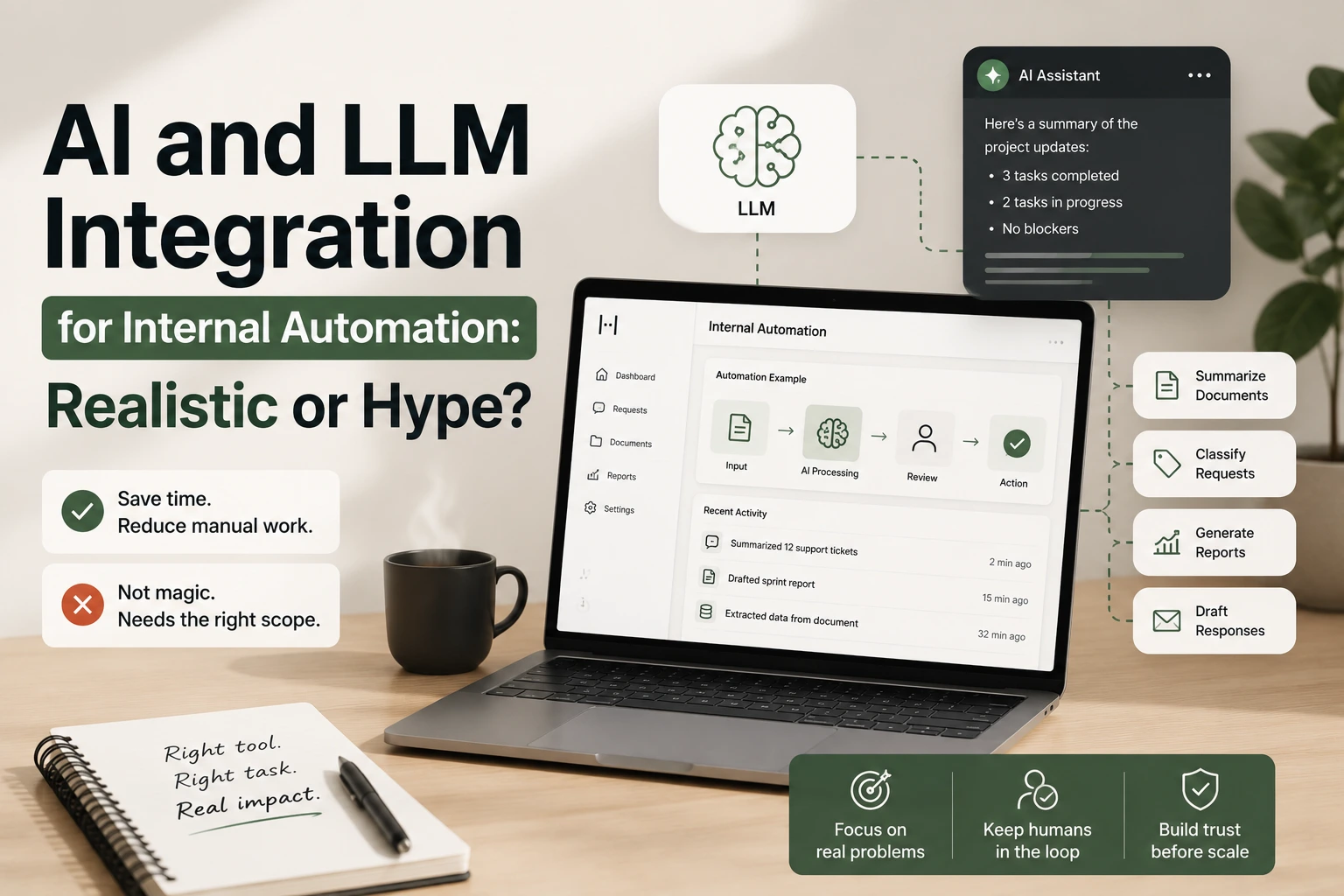
LLM integration for internal automation is realistic, not hype, when it is applied to narrow tasks with a clear input, a clear output, and a human still reviewing the result before anything important happens because of it. Summarizing a long ticket thread, drafting a first version of a report, classifying incoming requests, or extracting structured data from unstructured text are all tasks where LLMs consistently save real time.
It becomes closer to hype when it is framed as replacing an entire process end to end, particularly one involving judgment calls, financial decisions, or actions that are hard to reverse if the model gets it wrong. The technology has not failed in those cases so much as the scope was wrong from the start.
Where it genuinely works: narrow, bounded, reviewable tasks
The internal automation that has held up well over time shares three characteristics. The task has a clear, well-defined input. The output is something a human can quickly verify as right or wrong, even if they did not write it themselves. And a person is still in the loop before the output triggers any real-world consequence.
A sprint reporting bot that reads raw activity from a project tracker and drafts a plain-language summary fits this well. The input is structured, the output is easy to skim and correct, and nobody acts on the summary without a human glancing at it first. Similarly, an HR-facing tool that drafts a first version of a policy explanation or an onboarding email based on a template and some variables saves real time, because the person reviewing it is checking tone and accuracy, not verifying a decision with consequences.
Classification tasks tend to work well for the same reason. Sorting incoming support requests by category, flagging urgent items, or tagging documents by type are all tasks where an LLM's occasional mistake is low stakes and easy to catch, since a human downstream is still looking at the categorized result before acting on it.
Where it turns into hype: judgment, irreversibility, and unclear scope
The failure pattern is just as consistent as the success pattern. It shows up when a team frames the automation goal as "let the AI handle this whole process" rather than "let the AI handle this specific step within the process." A financial approval workflow that lets a model decide whether to approve a payment without a defined review step is not automation, it is an unmonitored decision with real money attached, and it tends to erode trust the first time it gets something wrong in a way nobody catches until later.
The same pattern shows up with anything involving nuanced judgment about people, performance reviews, disciplinary decisions, or anything where the "right" answer depends on context the model was never given and cannot infer reliably. These are not failures of the technology in some abstract sense. They are failures of scoping a bounded, verifiable task versus scoping an entire judgment call and hoping the model absorbs the missing context on its own.
Vague, open-ended automation goals fail for a related but different reason. "Build an AI assistant for the team" without a specific task attached tends to produce something that technically works in a demo and then goes unused within a month, because nobody has a specific moment in their day where they know to reach for it. The tools that get used daily are the ones solving one recognizable, recurring annoyance, not the ones trying to be a general helper for everything.
The reliability question nobody wants to ask upfront
Every LLM integration eventually runs into the same uncomfortable question: how often is it actually right, and does anyone actually know. Teams frequently skip measuring this, relying instead on a general sense that the tool "seems pretty good," which is not the same as having an actual error rate.
For low-stakes tasks like drafting a first version of a message, this gap does not matter much, since a human is reviewing and editing the output anyway. For anything higher stakes, this becomes the deciding factor in whether the automation is trustworthy enough to rely on. Before scaling any AI-based internal tool past an initial pilot, it is worth deliberately testing it against a batch of past real examples where the correct answer is already known, and actually counting how often it gets close enough to be useful without a heavy edit.
Skipping this step is how teams end up with an automation tool that quietly gets ignored by staff who have learned not to trust its output, which is a worse outcome than never building it, since it wastes the investment and leaves the original manual process running anyway.
Cost is rarely the real constraint, trust is
A common assumption is that LLM API costs are the main barrier to internal automation. In practice, for internal tools with reasonable usage volume, the API cost is usually a minor line item compared to the engineering time spent building the integration and the ongoing time spent maintaining it. The real constraint is trust: whether staff actually believe the output enough to use it without re-doing the work manually anyway.
Trust gets built the same way with AI tools as with any new internal process: consistent, visible correctness over time, starting with low-stakes tasks where a mistake costs almost nothing, before expanding to anything with more weight attached. Trying to earn trust by starting with a high-stakes task is backwards, and it is one of the more common reasons a promising internal AI project gets shelved after a rough first month.
A simple framework for deciding where AI fits
Common mistakes
The most common mistake is scoping the automation around the whole process instead of the one step that is actually tedious. A team wanting to automate customer onboarding often does not need an AI system that handles onboarding end to end. They need the ten minutes of manual data entry or the first-draft welcome email handled automatically, while everything requiring actual judgment stays with a person.
The second mistake is skipping the measurement step and moving straight from a promising demo to full rollout, without testing the tool against a real batch of past cases to know its actual error rate. A demo with three cherry-picked examples says very little about how the tool performs across the full range of real inputs it will eventually see.
The third mistake is treating AI integration as a one-time build rather than something that needs occasional review as the underlying process changes. A classification tool trained around last year's categories will quietly get less accurate as the business evolves, and nobody notices until someone points out that half the recent items were miscategorized.
Frequently asked questions
Is LLM integration actually useful for internal automation, or is it mostly hype?
It is genuinely useful for narrow, well-defined tasks like summarization, drafting, classification, and data extraction, particularly when a human still reviews the output. It becomes closer to hype when applied to entire processes involving judgment or irreversible decisions without a review step.
What internal tasks are the safest starting point for AI automation?
Tasks with low stakes if the model makes a mistake, such as drafting a first version of a report or summary, are the safest starting point. They let a team build trust in the tool before applying it to anything with real consequences.
Should AI make decisions automatically in internal workflows?
Only for low-stakes, easily reversible decisions. For anything involving money, legal exposure, or judgment about people, a human review step should remain in place rather than letting the output act automatically.
How do you know if an AI automation tool is actually working well?
By testing it against a batch of past real cases where the correct answer is already known, and measuring how often the output is close enough to be useful without heavy editing, rather than relying on a general impression from a small number of demo examples.
Key takeaways
- LLM integration works reliably for narrow tasks with a clear input, a clear output, and a human review step before anything important happens.
- It turns into hype when applied to an entire process involving judgment, irreversible decisions, or vague, open-ended goals with no specific task attached.
- API cost is rarely the real constraint. Staff trust in the output is the actual bottleneck, and it needs to be earned starting with low-stakes tasks.
- Measure actual accuracy against real past cases before scaling past a pilot, rather than relying on a general sense that the tool "seems good."
- Review AI-based automation periodically, since accuracy quietly drifts as the underlying process changes.
The realistic answer sits between the two extremes people usually pick. AI is not a general fix for messy internal processes, and it is not empty hype either. It is a genuinely useful tool for a specific, narrower category of tasks than most teams initially assume, and the automation projects that succeed are almost always the ones that respected that boundary from the start.
Working through a similar product or engineering decision?
Tell me what you are building and where the uncertainty is. I help founders clarify product requirements and translate them into a scoped, reliable technical plan.
Discuss Your Project