Why the topic matters
Most booking system requests start the same way: "we just need something simple, like Calendly but for our business." Then the actual conversation begins, and it turns out the business has three practitioners with different schedules, a deposit policy that changes by service type, a cancellation window that the front desk enforces manually today, and a spreadsheet that someone updates by hand every morning to avoid double bookings.
A booking system is not a calendar with a form attached to it. It is the layer that decides whether a business gets paid on time, whether a client shows up, and whether two people end up assigned to the same slot. Get the core features wrong, and the business ends up doing the same manual work it had before, just with an extra login screen in front of it.
This is based on building and reviewing booking systems for retreat operators, service businesses, and clinics, including a white-label booking platform designed for multi-client deployments and a retreat and experience booking concept built specifically for Southeast Asian operators. The patterns repeat across almost every industry that sells time slots.
Context and assumptions
This breakdown applies to any business that sells appointments, sessions, classes, or multi-day experiences: clinics, therapists, salons, consultants, retreat operators, fitness studios, and similar service businesses. It assumes the business has more than one resource being scheduled, whether that is multiple practitioners, multiple rooms, or multiple session types, since single-calendar businesses have simpler needs than what is covered here.
A booking system's real job is not showing available times. It is preventing conflicts, collecting payment reliably, and reducing no-shows, all without adding manual work for staff.
If the business only ever has one person taking one type of appointment with no payment collection, a generic scheduling tool is often enough and building something custom is not worth the cost. Everything below assumes the business has outgrown that.
The short answer
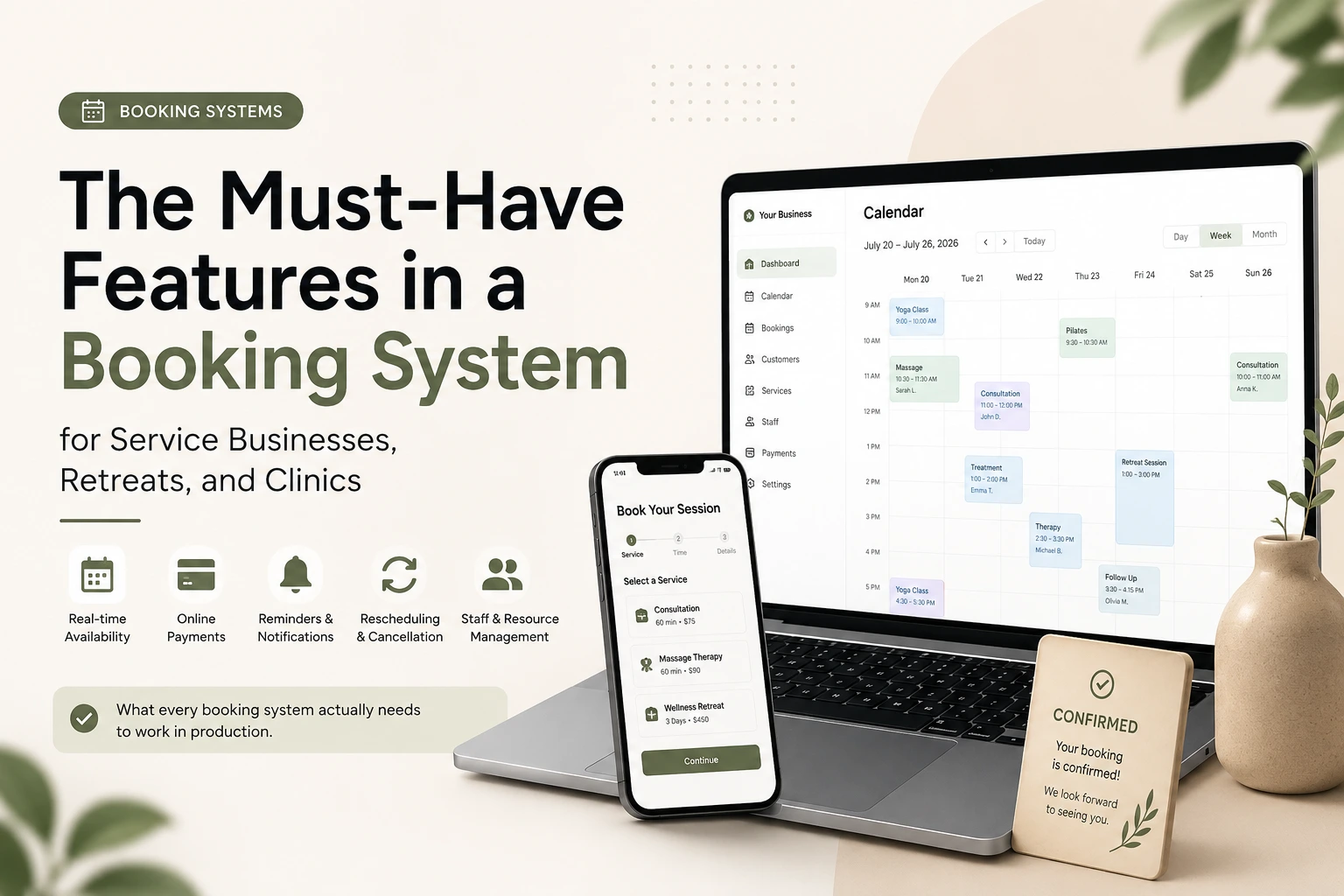
If I had to name the non-negotiable core, it would be five things: real-time availability that accounts for buffer time and resource conflicts, deposit or full payment collection at the point of booking, automated reminders through at least one channel, a clear cancellation and rescheduling policy enforced by the system rather than by staff memory, and a staff-facing view that shows the full day without requiring a second tool.
Everything past that core is either a nice differentiator or a distraction, depending on the business model. The rest of this article explains why each one matters and where I have seen teams skip them and regret it later.
Real-time availability and conflict prevention
This sounds obvious until you look at how many booking systems get it wrong. Availability is not just "is this time slot empty." It needs to account for buffer time between appointments, the specific resource being booked (a practitioner, a room, a piece of equipment), and any existing holds that have not been confirmed yet.
A clinic booking a 30-minute consultation but needing 15 minutes of cleanup and notes afterward is not actually free again in 30 minutes. If the system does not model that buffer, staff end up double booked on paper but not in reality, and the front desk goes back to manually blocking time, which defeats the purpose of automating this in the first place.
For retreat operators, this gets more complex, since a booking is not a single slot but a date range tied to a limited number of spots. The system needs to track capacity per session or per departure date, not just a single calendar entry, and it needs to release that capacity correctly if a booking is cancelled or a hold expires without payment.
Payment collection at the point of booking
A booking without payment attached is a maybe, not a booking. This is the feature that gets deprioritized most often during MVP scoping, usually because payment integration feels like the hard part, and it is the part that most directly affects whether the business can actually rely on the system.
For clinics and service businesses, this is usually a deposit, a percentage or fixed amount collected to secure the slot, with the balance paid at the appointment. For retreats, it is often a larger deposit with a balance due closer to the departure date, sometimes with a payment plan across multiple installments.
The payment provider choice matters more than people expect. For an Indonesian or Southeast Asian client base, Midtrans or Xendit support the payment methods people actually use day to day, including e-wallets, virtual accounts, and QRIS. For an international audience paying in USD or EUR, Stripe is the more reliable choice, with better subscription and installment tooling. Picking the wrong provider for the audience does not just cause minor friction, it directly reduces how many people complete a booking at all. (If you need help integrating these, see my SaaS development services).
Automated reminders and confirmations
No-shows are a business's most expensive silent cost. A missed appointment slot is not just a missed session, it is lost revenue that cannot be recovered once the time has passed, and clinics in particular tend to underestimate how much of their weekly loss comes from clients simply forgetting.
The minimum viable version of this feature is a confirmation message sent immediately after booking, plus a reminder sent 24 hours before the appointment, through email or WhatsApp depending on which channel the client base actually checks. For clinics and service businesses working with an Indonesian client base, WhatsApp reminders consistently perform better than email, simply because that is where people are already paying attention.
This does not need to be sophisticated at MVP stage. A scheduled job that checks for upcoming appointments and sends one reminder is enough to meaningfully reduce no-shows. Multi-step reminder sequences, SMS fallback, and reschedule links inside the reminder itself are good additions, but they are refinements on top of a feature that needs to exist at all first.
Cancellation and rescheduling policy enforced by the system
Every service business already has a cancellation policy. The problem is that it usually lives in someone's head, or in a sign at the front desk, and gets enforced inconsistently depending on who answers the phone that day. A booking system needs to encode that policy directly: how many hours or days before the appointment a client can cancel for a full refund, what happens to the deposit if they cancel later than that, and whether rescheduling is allowed and how many times.
This matters for two reasons. First, it removes an uncomfortable conversation from staff, who no longer have to personally decide whether to bend the rule for a specific client. Second, it makes the business's cash flow more predictable, since deposits that are correctly forfeited according to policy do not need to be manually tracked and argued about later.
For clinics with medical or therapy appointments, this policy also needs to interact correctly with the appointment reminder system. A client who cancels within the policy window should have their slot released back into availability immediately, not held until someone manually notices it is empty.
A staff-facing view that actually replaces the old tool
This is the feature that determines whether staff actually adopt the system or quietly go back to the spreadsheet. If the staff-facing calendar does not show the full day at a glance, does not let someone block time manually for a walk-in or a personal appointment, and does not show which bookings are paid versus pending, the front desk will keep a second source of truth running in parallel, and the two will eventually disagree with each other.
For multi-practitioner clinics, this view needs to filter and color-code by practitioner or room, since a single merged calendar becomes unreadable past two or three resources. For retreat operators managing a small team, a simpler day-by-day or trip-by-trip view is usually enough, since the volume of individual sessions is lower but each booking carries more information, such as dietary needs, room assignments, or group size.
Feature priority by business type
Common mistakes
The most common mistake is building the booking flow before building the cancellation and payment policy logic, treating them as an afterthought to add once the calendar works. In practice, these policies are where most of the actual business rules live, and retrofitting them after the booking flow is already built usually means reworking large parts of it.
The second mistake is underestimating how much manual override staff will need. A system that only supports client-initiated booking, with no way for staff to manually add, move, or block a slot, will get abandoned the first time a walk-in client or a phone booking needs to be entered by hand.
The third mistake is choosing a payment provider based on what is easiest to integrate rather than what the client base actually uses. A clean Stripe integration that no local customer can pay through is not actually simpler, it is simply broken in a way that only shows up after launch.
Frequently asked questions
What is the single most important feature in a booking system?
Payment collection at the point of booking. A slot reserved without payment attached is not reliable for either the business or the client, and it is the feature most likely to cause revenue loss if skipped or deprioritized.
Do small clinics with one practitioner need a complex booking system?
No. A single-practitioner clinic with straightforward appointment types can usually run on a simpler scheduling tool. Custom booking system features become worth building once there are multiple practitioners, multiple locations, or a deposit and cancellation policy that needs consistent enforcement.
Why do reminders matter more for clinics than for most other businesses?
Because a missed clinical appointment is a lost time slot that cannot be resold on short notice, unlike a retail transaction. Reducing no-shows through reminders has a direct and measurable effect on a clinic's weekly revenue.
Should retreat bookings use the same system as single-session appointment bookings?
Not usually the same underlying model. Retreat bookings need capacity tracking per date or session rather than single time slots, along with support for deposits and balance payments over time, which single-session booking tools are not built to handle well.
Key takeaways
- Availability needs to account for buffer time and resource conflicts, not just whether a time slot is technically open.
- Payment collection at the point of booking should be treated as core functionality, not an add-on, and the provider should match how the client base actually pays.
- Automated reminders through the channel clients actually check, often WhatsApp for an Indonesian client base, meaningfully reduce no-shows.
- Cancellation and rescheduling policy needs to be enforced by the system itself, not left to staff judgment on a case-by-case basis.
- A staff-facing calendar that does not fully replace the old manual process will get abandoned in favor of the old process.
The booking systems that actually get used long term are rarely the ones with the most features. They are the ones where the core five, availability, payment, reminders, policy enforcement, and a usable staff view, work reliably enough that staff stop trusting the spreadsheet more than the software.
Working through a similar product or engineering decision?
Tell me what you are building and where the uncertainty is. I help founders clarify product requirements and translate them into a scoped, reliable technical plan.
Discuss Your Project