Why the topic matters
Ask most service business owners how client communication works, and the answer is almost always some mix of WhatsApp and email, sometimes a shared Google Drive folder if the business is a little more organized. It works fine for the first handful of clients. Nobody questions it, because switching to something else feels like unnecessary overhead for a problem that does not seem urgent yet.
The problem shows up quietly, not as a single dramatic failure but as a slow accumulation of small ones. A file gets sent in the wrong WhatsApp thread. An approval happens over a phone call and never gets written down anywhere. A client asks "what's the status" for the third time this week because there is no single place to check. None of these individually feels like a real problem. Together, across a growing client list, they add up to hours of lost time and a client experience that starts to feel disorganized even when the actual work being delivered is good.
This is based on building internal tools like ADS Client Desk and reviewing client portal needs as part of scoping service offerings, where this exact pattern shows up almost every time a service business grows past a handful of active clients.
Context and assumptions
This is written for service-based businesses managing ongoing, multi-step engagements with clients, agencies, consultants, developers, clinics with case management needs, and similar businesses where a single client relationship involves more than one exchange over time. It assumes there is already more than one active client relationship running at once, since a business with a single client and a short, simple engagement has less need for this.
WhatsApp and email are communication tools. A client portal is a system of record. The moment a business needs to answer "what is the current status" without asking someone, it has outgrown communication tools alone.
If a business only ever does one-off, single-interaction work with no ongoing status to track, a client portal adds complexity without a corresponding benefit. This is written for businesses further along than that.
The short answer
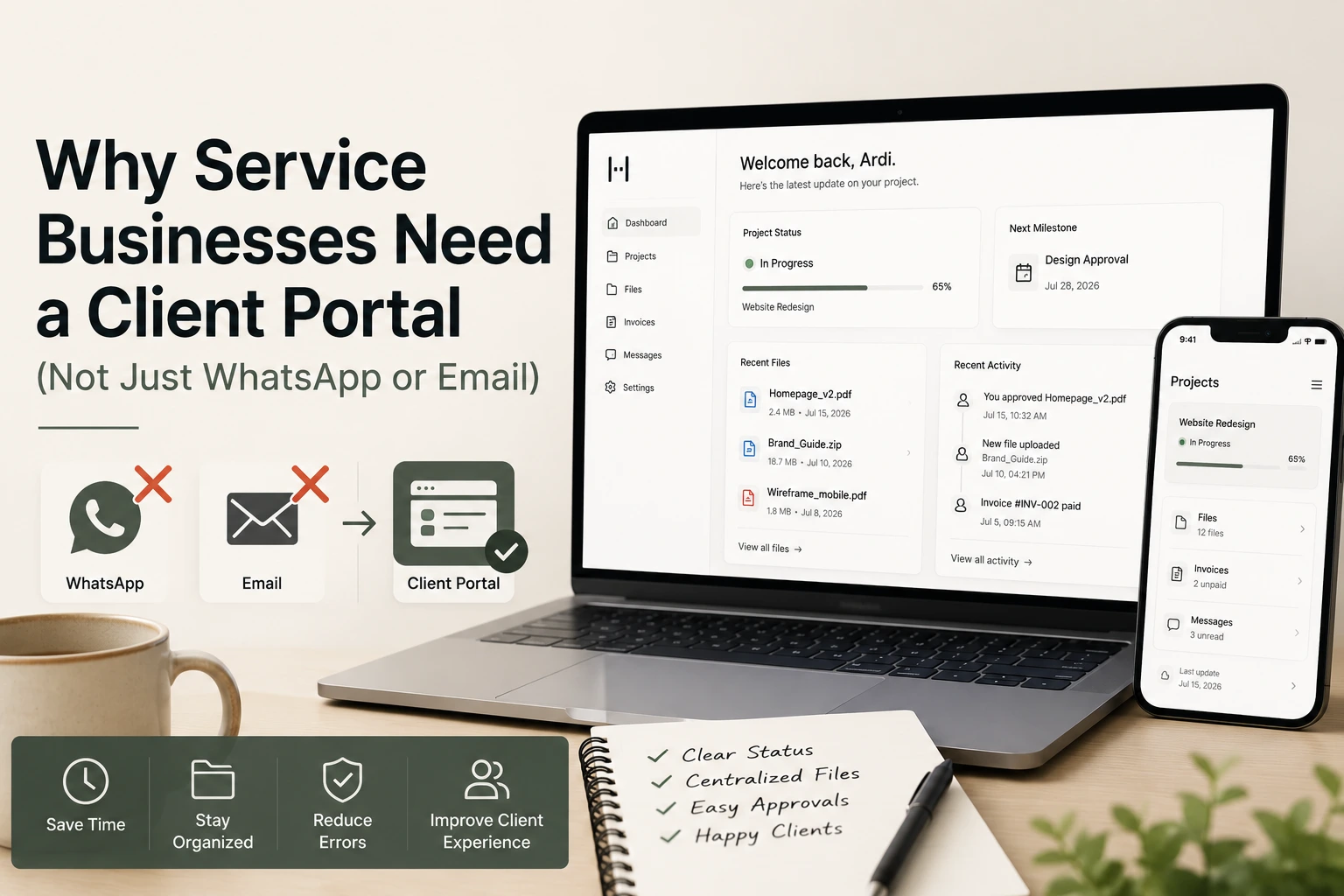
The core problem a client portal solves is this: WhatsApp and email are built for conversation, not for state. Neither tool has a native concept of "where things currently stand." Status lives in someone's memory, or has to be reconstructed by scrolling back through a chat thread. A client portal exists to hold that state directly, so status, files, approvals, and history are visible without anyone having to remember or search for them.
The businesses that benefit most are ones with repeat client engagements, multi-step deliverables, approval steps that need a paper trail, or a client list large enough that founders can no longer personally remember the status of every relationship. If none of those apply yet, WhatsApp and email are still the right tool for the job.
The problem with status living in someone's head
In a WhatsApp-and-email workflow, the current status of a project usually exists in exactly one place: whoever has been personally handling that client. If that person is unavailable, sick, or simply juggling too many active conversations, the honest answer to "what's the status" becomes "let me check and get back to you," which is a small thing that quietly erodes client confidence every time it happens.
A client portal removes this dependency by making status a field, not a memory. A project has a stage, a deliverable has a state, an invoice has a status. Anyone on the team, and often the client themselves, can see the current state without needing to interrupt someone else's day to ask.
Files and approvals need a paper trail, not a chat thread
Approvals over WhatsApp or email feel fast in the moment and become a liability the moment there is a disagreement later. "I thought you approved the second draft" is a much harder conversation to resolve when the approval happened as a thumbs-up emoji buried three hundred messages back, compared to a portal where an approval is a timestamped action tied directly to a specific version of the deliverable.
This matters even more for businesses handling client files, design drafts, legal documents, or medical records. A shared chat thread is not a reliable file system. Files sent over WhatsApp get compressed, links in email get lost in someone's inbox, and there is rarely a clear answer to "is this the latest version" once a document has gone through a few rounds of revision. A portal that keeps one authoritative version of each file, with a visible history of changes and approvals, removes this entire category of confusion.
Client-facing professionalism scales differently than founder-facing hustle
Early on, personal WhatsApp responsiveness is often a genuine competitive advantage. Clients feel like they have direct access to the person doing the work, and that responsiveness builds trust quickly. This does not scale the same way as the client list grows. The same responsiveness that felt personal with five clients becomes unsustainable with twenty five, and the quality of communication starts to visibly decline as messages get missed or answered late.
A client portal does not remove personal communication, it removes the parts of communication that do not need to be personal. Routine status checks, file delivery, and invoice visibility move into the portal, which frees up direct conversation for the parts that actually benefit from it, like discussing strategy or handling something genuinely urgent.
Security and access control that a chat app was never built for
WhatsApp and email were not designed with client data segregation in mind. Anyone with access to a shared device or an old thread can see everything, and there is no clean way to revoke a client's access to past conversations once an engagement ends. For businesses handling anything sensitive, financial documents, medical case notes, legal files, this is a real liability, not just an inconvenience.
A client portal with proper authentication solves this directly. Each client sees only their own information, access can be revoked cleanly when an engagement ends, and there is a clear audit trail of who accessed or changed what. This is the same reasoning that applies to multi-tenant data isolation in a broader SaaS product, applied specifically to the relationship between a business and its clients.
When WhatsApp and email are still the right call
Common mistakes
The most common mistake is building a client portal that simply recreates a chat interface, essentially rebuilding WhatsApp inside a browser tab. If the portal's main feature is messaging, it competes with a tool clients already have open all day and rarely wins that fight. A portal earns its place by holding state, status, files, approvals, and history, not by trying to replace conversation entirely.
The second mistake is rolling the portal out to all clients at once before the workflow is proven. It is usually better to pilot it with a handful of active clients, work out where the status model does not match reality, and then expand, rather than discovering gaps in the workflow after every client has already been migrated over.
The third mistake is underestimating how much client behavior needs to shift alongside the tool. If clients are used to reaching the business instantly over WhatsApp, a portal that requires a login and offers no urgent-contact path will get ignored in favor of the old habit. The strongest setups keep a direct line open for genuinely urgent matters while moving routine status and files into the portal.
Frequently asked questions
At what point does a service business actually need a client portal?
Roughly when a founder or team can no longer personally remember the current status of every active client relationship without checking a chat thread first, or when approval disputes and lost files have already caused a real problem at least once.
Does a client portal replace WhatsApp or email entirely?
No, and trying to make it do that usually fails. The portal should hold status, files, and approvals, while WhatsApp or a direct line stays available for genuinely urgent or personal conversation.
Is a client portal worth building for a small business with only a few clients?
Usually not yet. The value comes from removing the burden of tracking many relationships at once. With only a handful of clients, memory and a simple shared folder are often still sufficient.
What is the biggest risk of using only WhatsApp and email for client management?
The biggest risk is that project status and approval history exist only in individual memory or scattered chat threads, which creates real exposure if there is ever a dispute, a staff change, or a client asking for a clear record of what was agreed.
Key takeaways
- WhatsApp and email are conversation tools, not systems of record, and status that only lives in someone's memory does not scale past a handful of clients.
- Approvals need a timestamped, version-linked paper trail, not a chat message that gets buried within days.
- A client portal frees founder time by moving routine status checks and file delivery out of direct conversation, without removing the personal contact that still matters.
- Data sensitivity and access control are real reasons to move off chat tools, not just convenience.
- The portal should hold state, not try to replace conversation entirely, or it will lose to the chat app clients already have open.
A client portal is not about looking more professional for its own sake. It exists because communication tools were never built to hold state, and once a business has enough active relationships that status starts living only in someone's memory, that gap becomes a real operational cost rather than a minor inconvenience.
Working through a similar product or engineering decision?
Tell me what you are building and where the uncertainty is. I help founders clarify product requirements and translate them into a scoped, reliable technical plan.
Discuss Your Project