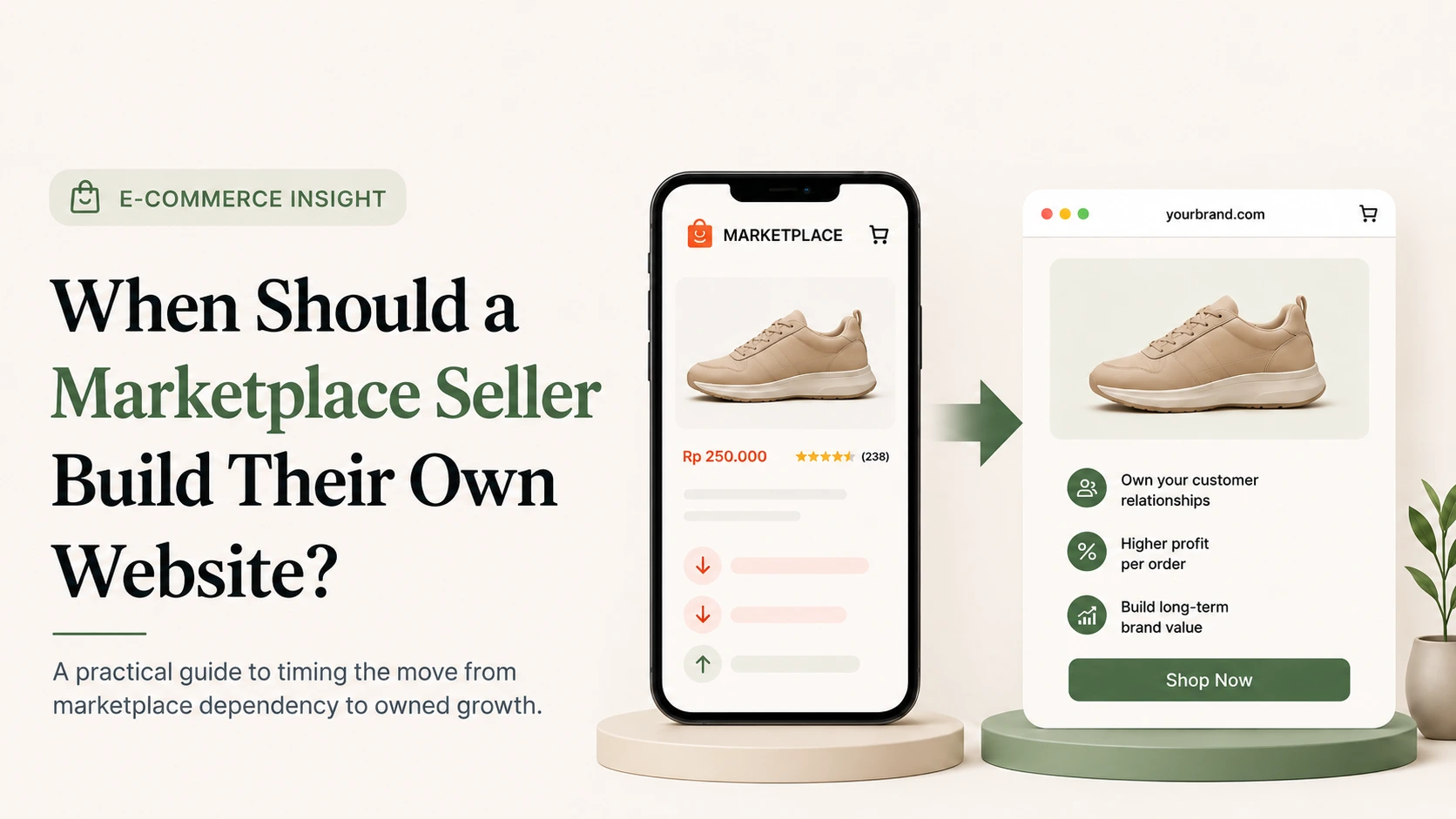
Why the topic matters
Every seller who has been on Shopee or Tokopedia long enough eventually asks the same question: should I have my own website by now. Usually it comes up right after a big sales day, when the platform's cut on that day's revenue finally gets added up and looked at directly instead of absorbed quietly into the margin.
The honest answer is that most sellers ask this question too late or too early. Too late, and they have spent years handing over 20 to 28 percent of every transaction in effective fees, with zero ownership of the customer relationship to show for it. Too early, and they end up with a website nobody visits, running in parallel with a marketplace store that still does all the actual selling, because the fundamentals that make an owned store viable were never actually there. (If you are ready to make the jump, I build owned commerce platforms designed to solve this).
This is based on building josjis.com, a productized service specifically for Indonesian marketplace sellers making this move, and on reviewing the same decision for other sellers weighing whether the timing is right for them.
Context and assumptions
This is written for sellers currently operating primarily or entirely on marketplaces like Shopee, Tokopedia, or similar platforms, selling physical products with at least some repeat purchase behavior. It assumes the seller has real sales history to look at, since this decision should be made from data, not from a general feeling that "marketplace fees are getting worse."
An owned website does not replace a marketplace. It adds a second channel with a different cost structure and different rules, and it only makes sense once the first channel has generated enough signal to justify it.
If a seller has fewer than a handful of months of consistent sales, or has not yet found a product-market fit that produces repeat customers, building a website is premature. The rest of this article assumes that baseline already exists.
The short answer
There is no single revenue number that applies to every seller, but the signals that consistently matter are these: marketplace fees have become a significant and predictable drag on margin, a meaningful share of customers are repeat buyers rather than one-time purchasers, the seller has enough order volume to justify the operational overhead of a second channel, and there is at least one marketing channel outside the marketplace's own search and ads that can drive traffic to an owned store.
If two or more of these are true, building an owned store is usually worth it. If none are true yet, the better move is to keep optimizing the marketplace listing and revisit the decision in a few months.
Signal one: the fee math has stopped being background noise
Marketplace fees in Indonesia are rarely just the platform's base commission. By the time payment processing fees, ad spend to stay visible in search, promotional program participation, and shipping subsidies are added together, the effective deduction on a transaction commonly lands somewhere between 20 and 28 percent, depending on category and how aggressively the seller is running ads to stay competitive.
For a seller doing a small volume of sales, this feels like a rounding error next to the convenience of marketplace traffic. For a seller doing meaningful monthly revenue, this stops being background noise and becomes the single largest line item after cost of goods. The moment a seller can point to a specific Rupiah figure lost to fees every month, and that figure is large enough to fund a website and its ongoing costs multiple times over, the math starts to justify the move on its own.
The mistake here is comparing marketplace fees to zero, as if an owned store has no costs of its own. It does, hosting, payment gateway fees, and the seller's own marketing spend to replace what the marketplace's built-in traffic used to provide for free. The comparison that actually matters is marketplace fees versus owned-store operating costs plus the cost of driving your own traffic, not marketplace fees versus nothing.
Signal two: repeat customers exist and are currently invisible to the seller
This is the signal sellers underweight the most, and it is often the strongest one. On a marketplace, a seller typically cannot see who their repeat customers are, cannot message them directly outside of order-related notifications, and cannot build any kind of retention program around them. Every repeat purchase happens despite the platform's design, not because of any tool the seller has access to.
If a seller looks at their order history and finds a meaningful share of customers buying more than once, that is a direct signal that brand loyalty already exists independent of the marketplace's own recommendation algorithm. An owned store lets that loyalty finally be captured, through email, WhatsApp broadcast lists, or simple repeat-purchase incentives that a marketplace listing has no mechanism for.
If, on the other hand, every sale looks like a one-time transaction driven entirely by marketplace search ranking or a flash sale, an owned website will not fix that on its own. Repeat behavior needs to already exist in some form before a website can amplify it.
Signal three: order volume can absorb the operational overhead
An owned store is not zero maintenance. Someone needs to manage inventory sync if it is not fully automated, handle payment gateway reconciliation, respond to customer support outside of the marketplace's built-in chat tools, and keep the site itself running. For a seller doing a handful of orders a week, this overhead can end up costing more in time than it saves in fees, at least in the first few months while the new channel is still building its own traffic.
The volume threshold where this starts to make sense is less about a specific number and more about whether the seller, or someone on their team, already has the operational capacity to run a second sales channel without the marketplace side suffering as a result. A seller who is already stretched thin fulfilling marketplace orders is not in a good position to also manage a website's customer support inbox.
Signal four: there is a real answer to "where does the traffic come from"
This is the signal most often skipped, and it is the one that turns an owned website into either a genuine second revenue channel or an expensive digital brochure nobody visits. A marketplace listing benefits from built-in search traffic and platform-wide promotions. A standalone website has none of that by default.
Before building the site, there needs to be a real answer to where its first customers will come from. That could be an existing Instagram or TikTok following, an email list built from past marketplace order data, a WhatsApp broadcast list of repeat customers, or a specific paid acquisition channel the seller already understands. If the honest answer is "we will figure out traffic after the site launches," the timing is premature, and it is often better to spend a few months building that audience first, even while still selling exclusively through the marketplace.
Reading the four signals together
Two or more signals pointing toward "ready" is usually enough to justify starting. All four pointing toward "not yet" is a clear sign to wait and keep strengthening the marketplace channel in the meantime.
Common mistakes
The most common mistake is building the website first and hoping traffic follows, essentially treating "having a website" as the strategy rather than a tool that only works alongside an actual traffic plan. A well-built site with zero visitors performs identically to no site at all, just with added hosting costs.
The second mistake is underestimating how much of the marketplace fee is actually paying for something real, namely trust and discovery. New customers on a marketplace already trust the platform to handle disputes and refunds, and they are actively searching within it. An owned store has to earn that trust and discovery from scratch, which is exactly why an existing audience or repeat customer base matters so much before making the switch.
The third mistake is treating this as an all-or-nothing decision. The strongest position for most sellers is running both channels at once, using the marketplace as an ongoing acquisition source while the owned store captures repeat customers and higher-margin transactions over time, rather than abandoning the marketplace entirely on day one.
Frequently asked questions
What percentage of revenue do marketplace fees typically take in Indonesia?
Effective deductions, including commission, payment processing, and ad spend needed to stay visible, commonly land between 20 and 28 percent of a transaction, though this varies by product category and how competitive the seller's niche is.
Should a seller stop selling on the marketplace once they launch their own website?
Usually not immediately. The stronger approach is running both channels together, keeping the marketplace as an acquisition source while the owned store focuses on repeat customers and better margins, then adjusting the balance over time based on actual results.
How much repeat purchase behavior is enough to justify an owned store?
There is no fixed percentage, but if a meaningful share of a seller's order history shows the same customers buying more than once, that is a strong signal that brand loyalty already exists and is currently going uncaptured by the marketplace relationship.
Is it worth building an owned website with no existing audience or traffic source?
Generally no, not yet. Without an existing audience, an owned store has no reliable way to attract its first customers, and it is usually better to spend time building an audience, through social media, an email list, or a WhatsApp customer list, before investing in the site itself.
Key takeaways
- Compare marketplace fees to the real cost of running an owned store and driving your own traffic, not to zero.
- Repeat customers are the strongest signal an owned store will work, since that loyalty already exists but is currently invisible and uncapturable on the marketplace.
- Order volume needs to be high enough that a second channel's operational overhead does not pull focus away from the marketplace business that is still funding everything.
- Have a real answer for where first traffic will come from before building the site, not after.
- Treat this as adding a channel, not replacing one, at least until the owned store has proven it can stand on its own.
The right time is not a revenue milestone written on a calendar. It shows up when the fee math, the repeat customer data, the team's capacity, and an actual traffic plan all point the same direction at once. Before that, the better investment is usually strengthening the marketplace presence itself.
Working through a similar product or engineering decision?
Tell me what you are building and where the uncertainty is. I help founders clarify product requirements and translate them into a scoped, reliable technical plan.
Discuss Your Project