Why the topic matters
The payment gateway question always comes up right after the booking flow itself is designed, and it almost always gets rushed. Founders and clinic owners assume this is a minor implementation detail, something the developer will just handle, and it is only after launch that the real consequences show up: a deposit that cannot be collected because the business entity does not qualify yet, or a retreat client who abandons checkout because their preferred e-wallet is not supported.
For a booking system specifically, the payment gateway is not just a checkout button. It decides whether a deposit policy can actually be enforced, whether a retreat's balance payment can be automated instead of chased manually, and whether an individual practitioner without a registered company can even accept online payments at all. Midtrans, Xendit, and iPaymu are the three names that come up most often for Indonesian booking systems, and each one fits a different stage and shape of business.
This is based on integrating payment providers into booking and client-facing systems for clinics, retreat operators, and service businesses, where the choice between these three has come up repeatedly and the right answer has rarely been the same twice. (If you need help building this, check out my SaaS development services).
Context and assumptions
This comparison is written specifically for booking systems in Indonesia: clinics, retreat operators, fitness studios, consultants, and similar service businesses that need to collect a deposit or full payment at the point of booking, and often need to collect a second payment later for a balance or installment. It assumes the business is choosing between these three specific providers rather than considering an international-first option like Stripe, since Stripe's support for common Indonesian methods like QRIS and local e-wallets remains limited compared to these three.
The right payment gateway for a booking system is not the one with the most payment methods listed on its homepage. It is the one that matches your business's legal status today and your deposit structure without extra workarounds.
If the business already has an established PT and processes a high volume of transactions, the calculation shifts toward reliability and support quality over ease of signup. If the business is a solo practitioner just starting out, the calculation shifts the other way.
The short answer
For a business that already has a registered company (PT) and needs the most mature ecosystem with strong recurring payment tooling, Midtrans is usually the safest default, backed by GoTo Financial and trusted at scale from small clinics to large platforms. For a business that wants a modern developer experience and may eventually serve customers or operate across Southeast Asia beyond just Indonesia, Xendit is the stronger fit, with fast onboarding and an API most developers find easier to work with. For a solo practitioner, a new clinic, or an individual retreat organizer who does not yet have a registered business entity, iPaymu is often the only realistic starting point, since it allows signup with just an ID card and includes escrow functionality that can help build trust around deposits before the business has an established track record.
Legal requirements decide who can even start
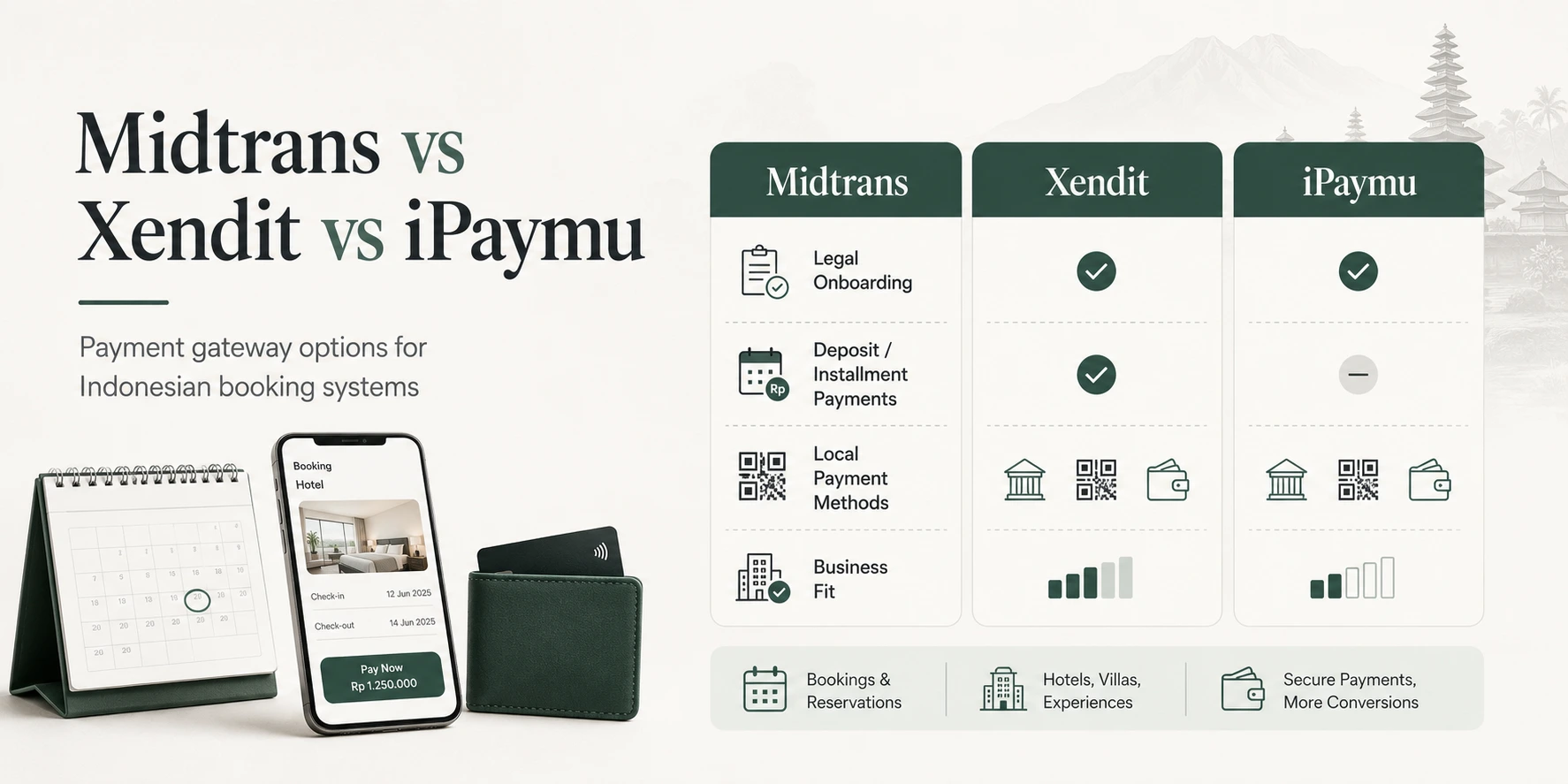
This is the factor that gets skipped most often in comparison articles, and it is the one that actually eliminates options first. Midtrans and Xendit both generally expect a registered business entity to unlock full functionality, and while a tax ID is not always strictly mandatory, it is commonly recommended to raise transaction limits and access the full feature set. For a clinic or studio that is already operating as a PT, this is a non-issue. For an individual therapist, a small retreat organizer running things solo, or a new business still in the process of registering, this can block signup entirely or leave the account stuck at a very low transaction limit.
iPaymu's main practical advantage here is that individuals can register and start accepting payments with just a KTP, no business entity required. This matters more for booking systems than it might seem, because a retreat organizer or independent practitioner testing whether their offering has demand should not be blocked from collecting a deposit simply because the paperwork for a formal company is not finished yet.
Payment method coverage for the guests who are actually booking
All three providers support the core methods Indonesian customers expect: bank transfer or virtual account, QRIS, and the major e-wallets. Where they start to differ is in the breadth of niche methods and how well each is documented and maintained over time, since payment method support in this market changes fairly often as new e-wallets and bank integrations get added or deprecated.
Midtrans, due to its GoTo Financial backing, tends to have particularly strong integration with GoPay specifically, along with broad bank and card support, which matters if a meaningful share of the client base already uses the Gojek ecosystem. Xendit's method coverage is comparably broad and its documentation tends to be clearer for developers implementing multiple methods at once. iPaymu also covers the core methods along with retail payment channels like Alfamart and Indomaret, which can matter for a retreat or clinic serving a client base outside major cities where over-the-counter payment is still a common habit.
Deposits, balance payments, and recurring charges
This is where the booking use case diverges most from a typical e-commerce checkout. A clinic collecting a deposit followed by a balance payment at the appointment, or a retreat collecting a deposit followed by an installment plan before departure, needs a provider that handles multi-step payment flows cleanly, not just a single one-time charge.
Midtrans has the most mature tooling here, with well-documented support for recurring and scheduled charges, which fits a retreat's installment structure or a subscription-style service well. Xendit supports similar functionality with a developer experience many find faster to implement correctly the first time, particularly for invoice-based flows where a balance payment needs to be requested and tracked separately from the initial deposit. iPaymu can handle a basic deposit-then-balance flow, but it is generally the least suited of the three for complex recurring or installment structures, which is worth knowing before committing to it for a retreat operator with a multi-payment plan already built into their pricing.
Escrow as a trust feature, not just a checkout method
iPaymu's escrow functionality is worth calling out specifically because it solves a problem that is more relevant to booking systems than it first appears. A new retreat operator or a clinic without an established reputation is asking a client to pay a deposit, sometimes a significant one, before receiving anything in return. Escrow means the funds are held by a neutral third party until the service is confirmed as delivered, which can meaningfully reduce a first-time client's hesitation to pay upfront.
Midtrans and Xendit do not center their offering around escrow in the same way, since they are built more around direct merchant settlement. For an established clinic or a retreat operator with years of reviews and repeat clients, this matters less, since trust already exists independent of the payment mechanism. For a new operator trying to convert their first cohort of clients, escrow can be a genuine conversion lever worth considering.
Developer experience and integration effort
For a developer actually building the booking system, this affects how long the payment integration takes and how much ongoing maintenance it needs. Xendit is generally considered to have the more modern, better-documented API among the three, with clearer webhook handling and a more predictable response structure, which tends to reduce integration time and the number of edge cases that surface after launch.
Midtrans's documentation and SDKs are mature and well-tested given how long the platform has been running at scale, though the developer experience can feel slightly more dated compared to Xendit's. iPaymu's documentation and SDK support are comparatively less extensive, which is a reasonable tradeoff for its easier onboarding but worth factoring in if the booking system needs a highly customized payment flow.
When regional reach actually matters
Most clinics and single-location service businesses have no real need to think beyond Indonesia. This becomes relevant specifically for retreat operators who host guests from outside Indonesia, or who plan to expand operations into other Southeast Asian markets. Xendit's presence across Indonesia, the Philippines, and Vietnam makes it the more natural choice if a booking system needs to eventually support guests or operations paying in more than one regional currency without switching providers entirely.
Comparing the three at a glance
Common mistakes
The most common mistake is picking Midtrans or Xendit by default because they are the names most often recommended online, without first checking whether the business's current legal status can actually unlock full functionality. A solo practitioner discovering mid-integration that their account is capped at a low transaction limit because they lack a registered entity is a frustrating and avoidable delay.
The second mistake is underestimating how much the deposit and balance payment structure matters for a retreat or clinic specifically. A generic one-time checkout integration is a very different build than a proper deposit-then-balance flow with correct handling of partial refunds under a cancellation policy, and choosing a provider without checking how well it supports that structure leads to workarounds being built manually later.
The third mistake is treating this as a permanent decision made once and never revisited. It is reasonable to start with iPaymu while a business is new and unregistered, then migrate to Midtrans or Xendit once the entity is formalized and transaction volume justifies the switch. The migration is real engineering work, but it is far less costly than being blocked from accepting payments at all in the early months.
Frequently asked questions
Can a solo practitioner or retreat organizer without a PT accept payments online in Indonesia?
Yes, through iPaymu, which allows individual signup using just a KTP rather than requiring a registered business entity. Midtrans and Xendit generally expect business registration to unlock full transaction limits.
Which payment gateway is best for a retreat with a deposit and installment payment structure?
Midtrans and Xendit both offer stronger tooling for recurring and scheduled payments, which better supports a deposit followed by installment payments before departure, compared to iPaymu's more basic payment flow support.
Does iPaymu's escrow feature matter for an established clinic?
Less so. Escrow mainly helps reduce hesitation from first-time clients paying a new or unproven business. An established clinic with existing trust and reviews generally does not need escrow as a conversion lever in the same way a new operator does.
Is it worth switching payment gateways later as a business grows?
Often yes. Starting with iPaymu while a business is new and unregistered, then migrating to Midtrans or Xendit once the entity is formalized and volume increases, is a reasonable path, even though the migration itself requires real engineering effort.
Key takeaways
- Legal entity status decides who can even sign up with full functionality, and this eliminates options before any feature comparison matters.
- iPaymu is the realistic starting point for solo practitioners and new operators without a registered company.
- Midtrans and Xendit both handle deposit-and-balance or recurring payment structures better, which matters specifically for retreats and installment-based bookings.
- Escrow is a genuine trust-building tool for new, unproven operators, and less relevant once a business already has an established reputation.
- Treat the payment gateway choice as something that can change as the business grows, not a permanent decision made once at the very beginning.
There is no universally correct answer among these three. The right choice depends on where the business actually stands today, its legal status, its deposit structure, and how much it needs client trust built into the payment flow itself, not on which provider has the longest feature list.
Working through a similar product or engineering decision?
Tell me what you are building and where the uncertainty is. I help founders clarify product requirements and translate them into a scoped, reliable technical plan.
Discuss Your Project